I devoured books as a child and teenager, hauling batches from the downtown Sarnia public library (sometimes the Bookmobile) and then returning them two weeks later for replacement. I don’t remember what all of it was (some Hardy Boys for sure), but there was one series of biographical books (American slant) that I read all of. About George Washington Carver, for example.
All of this reading was voluntary, though I’m sure my elementary school (SCS) encouraged me well. At twenty, I joined the Book of the Month Club and over some years built up a good collection of hard cover classics. Post Secondary, my readings tended to be required, and turned away from fiction towards scholarship. But I never stopped looking to other interests in book shops and used book stores.
When I left home in 1974 for an upper room overlooking Foxbar Road, up the Avenue from the University of Toronto, my library sat on three shelves supported by bricks. After marriage in 1980, I built the 8’ by 8’ oak bookcase that still anchors our living room. Then, four years later when I abandoned school at the age of 28 to join the real world, books took a back seat. And when the internet began insinuating itself, I often did more browsing than book reading.
But the books continued their stand — a testament to past pursuits and the lost luxury of time. It’s remarkable that so many, like me, keep books which they’ve read once and will probably never crack open again. Most of my books have no definable place in my brain. Even if I’ve read it recently, a book’s details cannot be ‘taken out’ and brought to mind except in vague ways. Photographic memory is ever more out of my reach.
So we must keep the books that have influenced us, or moved us, or that hold some promise — keep them for reference, or to instill mindfulness by their spines, or perhaps even for when we finally have time to read them. (I confess that I have not yet read my three volume Gulag Archipelago.)
Much like me, my book collection is eclectic and of no particular significance. But my books are not trivial, nor am I. Together we stand firmly in reputable traditions, whether they be gardening, ecology, photography, worship, philosophy or history. (Novels, short stories and poetry take up relatively little space in my collection — though my wife makes up for it with hers.) Some of the books are best sellers, some are deemed seminal, some are reactionary, but all are somehow significant.
But they are, together, by no means encyclopedic (like the the recently established Seerveld and Wolters collections), and there’s little point in trying to establish a beachhead in the various disciplines that engage me. Except perhaps for one. The way things are going right now, I feel a strong need to bring history up to the front where it can go head to head with competing visions of society and culture.
So I have taken stock of my history books, books that lie scattered around the house, to remind myself of the history of my histories — to make a virtual bookshelf that will also serve to engage others on the cultural front lines.
It is, no doubt, a curious collection. Because it is born of curiosity, and curiosity knows no bounds.
Notes: The book History of the Netherlands: A Captivating Guide to Ancient Germanic and Celtic Tribes, the Eighty Years’ War, the Dutch Empire and Republic, and Modern Times by the publisher Captivating History explores how a collection of low-lying states transformed into a global trading empire and a modern progressive nation. Overview of Key Historical Eras Covered: Ancient Beginnings & Roman Defiance: Documents how Stone Age societies flourished in a delta landscape without native stone resources. It details how local Germanic and Celtic tribes heavily resisted expansion when the Roman Empire attempted to push north past the Rhine River. Medieval Growth & Ingenuity: Explores the unique engineering feats of early Dutch communities, such as draining massive marshes and reclaiming land from the sea. It highlights how simple local innovations—like a new fish-pickling technique in the 14th century—unlocked major economic trade advantages across the region. The Eighty Years’ War (1568–1648): Recounts the dramatic Protestant religious awakening and subsequent fierce rebellion against the Catholic Spanish Habsburg Empire. Led by figures from the House of Orange, the northern provinces signed the Union of Utrecht, eventually winning formal independence as the Dutch Republic. The Dutch Golden Age & Global Empire: Tracks the spectacular rise of the nation into a global commercial superpower. It focuses on international trade advancements driven by the Dutch East India Company (VOC), breakthroughs of the Northern Renaissance, and the cautionary economic tale of the Tulip Mania market collapse. Modern Invasions & Post-War Transformation: Examines the far-reaching social and political consequences of being invaded by Napoleon’s armies in the 19th century and occupied by Nazi Germany during World War II. The text concludes by outlining the country’s evolution into a highly progressive, modern constitutional monarchy
Modernising Protestantism
A Cultural History of the Dutch Reformed 1650-1750
Acquired: 2026 Time Period: 1650-1750 Place: The Netherlands
AI Notes:modernising Protestantism: A Cultural History of the Dutch Reformed, 1650-1750 is an open-access academic book written by Dr. Joke Spaans and published by Routledge. The book challenges traditional church history, which often frames the Dutch public church in the late seventeenth and eighteenth centuries as a joyless, ossified, and declining institution. Instead, Dr. Spaans explores the dynamic interface between the Reformed church and a highly literate, incredibly wealthy Dutch Golden Age society. She demonstrates that rather than acting as a barrier to development, the state church was deeply integrated into early modern societal modernization, offering robust intellectual scholarship, spiritual solace, and cultural vitality to a broad public audience.
The Earth is all that Lasts
Crazy Horse, Sitting Bull, and the Last Stand of the Great Sioux Nation
AI Notes:The Earth Is All That Lasts: Crazy Horse, Sitting Bull, and the Last Stand of the Great Sioux Nation is a meticulous dual biography written by American West historian Mark Lee Gardner. The book provides a sweeping, non-fiction narrative that centers on the Native American perspective during the fierce final chapters of the Indian Wars. It highlights how the iconic Lakota leaders orchestrated the historic defeat of the U.S. Army at the Battle of Little Bighorn, while exploring the subsequent tragic erosion of their nomadic way of life. Core Narrative Themes: Two Contrasting Leaders: Gardner profiles Sitting Bull, the revered Hunkpapa Lakota holy man whose spiritual visions guided and foretold military triumphs, alongside Crazy Horse, the enigmatic and fiercely courageous Oglala war chief known for his tactical brilliance. The Encroachment of White Settlers: The biography tracks the rapid decay of Plains Indian sovereignty as fur traders, gold seekers, transcontinental railroads, and U.S. “Bluecoat” soldiers flooded sacred treaty lands. The Destruction of the Frontier: The narrative illustrates the catastrophic collapse of the vast buffalo herds and the spread of foreign diseases, which systematically decimated indigenous villages and forced tribes into a corner. A Triumphant Yet Pyrrhic Victory: The book details the stunning June 25, 1876 onslaught where the Lakota and Cheyenne crushed Lt. Colonel George Armstrong Custer’s Seventh Cavalry. While it was their greatest victory, it provoked a relentless federal campaign spearheaded by General William Tecumseh Sherman to exterminate or forcibly confine the Native bands. A Legacy of Defiance: The book concludes with the grim aftermath of the Sioux Wars, detailing how both defiant leaders eventually surrendered under extreme starvation conditions and later met violent, eerily similar deaths while resisting absolute confinement.
AI Notes:The Silk Roads: A New History of the World (2015) by Peter Frankopan is an ambitious, wide-ranging historical narrative that re-centers world history on Central Asia and the Middle East, challenging traditional Eurocentric views of global advancement. Instead of viewing the West as the historic incubator of progress, Frankopan argues that the true “spine” of global civilization lies in the vast interconnected trade networks stretching from the Mediterranean and the Persian Gulf across to China. Frankopan shifts the historical lens away from the rise of Rome, Western European exploration, and American exceptionalism. He highlights the region spanning from Baghdad to Chang’an (modern-day Xi’an) as the ultimate crossroads where empires collided, economies grew, and cultures blended. The book is structured chronologically into 25 thematic chapters, each titled “The Road to…” (e.g., The Road of Faiths, The Road of Gold, The Road of Black Gold) to trace how distinct global forces evolved.
In the Shadow of the Most High
Uncovering my Jewish Ancestors’ Perilous Journey Through History
Acquired/Read: 2026 (Kindle) Time Period: Abraham to 1706 Place: Israel to Essens, Germany
AI Notes:In the Shadow of the Most High: Uncovering My Jewish Ancestors’ Perilous Journey Through History is a narrative historical non-fiction book written by Doug Einfeld, a retired Christian minister and hospice chaplain. Published in May 2026, the book serves as the first volume in his series, Rediscovering Our Roots: Judeo-Christian History Revisited. The narrative centers on Einfeld’s unexpected discovery that his paternal family possessed hidden Jewish ancestry, despite generations of deep-rooted ties to the Christian Reformed Church. Core Plot and Historical Overview: The Discovery: Through careful genealogical research, Einfeld uncovers that his German ancestors bore the then-mandated surname “Juede” (Jew) but were baptized as Lutherans to survive. The Ancient Foundations: The narrative traces the genetic and cultural lineage of these ancestors back to the deserts of the ancient Near East, beginning with Abraham’s biblical covenant. The Intertestamental Period: It explores ordinary daily life during the 400 years of “silence” between the Old and New Testaments, contextualizing the sociopolitical strains under Greek and Roman rule. The Rise of Christianity: Einfeld maps out the ministry of Jesus of Nazareth, analyzing how the Gospel accounts emerged and charting the initial Jewish Jesus movement before it fractured away from mainstream Judaism. European Diaspora and Medieval Persecution: The text follows the family line into Europe, documenting centuries of survival through major historic events. It details the Babylonian exile, Pope Innocent III’s anti-Jewish decrees, the tragic 1510 massacre under Prince Joachim I, and the violent antisemitism of the Crusades. Settlement and Identity: The historical trajectory culminates in northern Germany, bridging ancient history with modern identity while evaluating modern Jewish-Christian relations
HdJ Notes: I came to this book in a curious way. After seeing Doug Einfeld’s name in a promotion of this (then) upcoming book, I initiated contact with Doug to confirm that his brother and I shared an apartment in Toronto for a year, long ago. I ended up on the book’s promotion list and purchased it as soon as it came out.
The book is not at all what I expected (Dutch genealogy explorations) and it’s also not like anything I’ve read before. It goes into detail retelling the story of Israel as we know it from the Bible, puts the New Testament into the context of a drawn out transition from Jewish faith in Christ to ‘gentile’ Christianity and documents the dispersion of persecuted Jews through the Middle East into Europe.
What comes across is a grand narrative of Jewish identity forging itself and meeting resistance (subjugation, persecution) over millennia and culminating in a single ancestor of Doug Einfeld who succumbed to the pressure and became Protestant.
As someone who also expects there to be Jews in my family tree and who is cognizant of the tremendous breadth of every person’s genealogical heritage, I can appreciate the sense of connection and continuity with real, flesh and blood persons from a very distant past. While we talk easily about being in the Covenant that Abraham entered into, some of us can also entertain the possibility of being directly descended from Abraham.
Acquired/Read: 2026 (Kindle) Time Period: 1609 – 2009 Place: Manhattan
Notes:Mannahatta: A Natural History of New York City is a groundbreaking historical ecology book by landscape ecologist Eric W. Sanderson. Published in 2009 to mark the quadricentennial of Henry Hudson’s arrival, the book comprehensively reconstructs the pristine, wild ecosystem of Manhattan Island exactly as it existed on the afternoon of September 12, 1609. The book stems from a decade-long research initiative called the Mannahatta Project at the Wildlife Conservation Society. Sanderson’s work was catalyzed by his discovery of an incredibly detailed 1782 British Headquarters Map. This historical artifact charted the island’s original, unmodified topography before it was flattened by urban grid construction. Using advanced Geographic Information Systems (GIS) and computer modeling, Sanderson “georeferenced” this map to modern coordinates. This allowed him to map ancient streams, hills, and wetlands directly onto modern street addresses.
HdJ Notes: The tension between nature (pristine) and culture (developed) is evident in discussions about colonialism and is worth exploring. But the reality of this transition throughout history and over all the world is fascinating, even without its socio-political baggage.
I am at heart (by necessity?) a settler who both modifies my landscape and pines for undisturbed nature. So this book’s description of the Manhattan Island just before my Dutch forbears settled it feels very poignant to me. I enjoyed reading it on my trip by train to New York City, much of it running along side the Mohawk and Hudson rivers.
Acquired/Read: 2025 Time Period: 430 – 1430 Place: Europe
AI Notes:The Bright Ages: A New History of Medieval Europe (2021) by Matthew Gabriele and David M. Perry is an accessible, revisionist history that overturns the persistent myth of the “Dark Ages.” Spanning roughly 1,000 years from the fifth to the fourteenth centuries, the book argues that medieval Europe was not a primitive, stagnant dungeon of ignorance, but rather a complex, interconnected, and diverse era filled with vibrant cultural exchange and intellectual life.
HdJ Notes: I have long been skeptical of the tendency to characterize Europe before the Reformation, Renaissance and Enlightenment as being the “Dark Ages.” So this book’s title caught my eye and has proved to be a welcome antidote.
Being rooted firmly in northern Europe, I found reading the book to be a bit of a slog as it roamed all over Eurasia through territories and cultures that were unfamiliar to me. But I persisted and am glad to have this as reference now for ideas that I have about my own culture and its roots.
Heirs of an Ambivalent Empire
French-Indigenous Relations and the Rise of the Metis in the Hudson Bay Watershed
Acquired/Read: 2024 / 2025 Time Period: 1663-1782 Place: Canada, Hudson Bay Watershed
AI Notes:Heirs of an Ambivalent Empire: French-Indigenous Relations and the Rise of the Métis in the Hudson Bay Watershed is a 2022 historical monograph written by Scott Berthelette and published by McGill-Queen’s University Press. The book re-evaluates early North American colonial history by examining how French-Canadian fur traders navigating the Hudson Bay watershed laid the foundational groundwork for the emergence of the Métis nation.
HdJ Notes: This book was a gift from my historian son Michael who lives within the lands that gave birth to the Métis, This is a scholarly work suggesting a new thesis for the origin of the Métis.
The book’s wealth of historical detail paints a vivid picture of Canadien Voyageurs, their kinship with the indigenous peoples and their gradual assumption of self identity. It stops short of that time when the Métis grew more organized (e.g. under Louis Riel).
Acquired: 2024/12 Time Period: 1636 – 1710 Place: Britain, North America
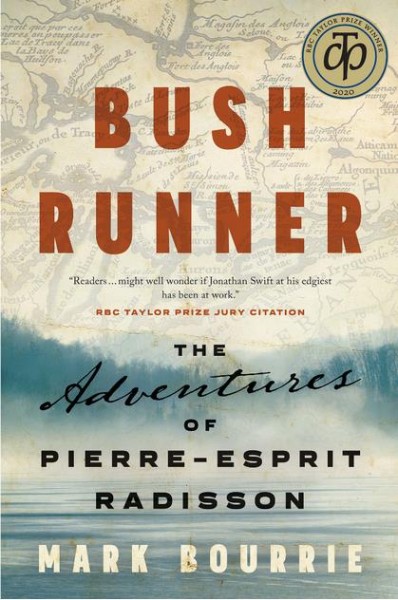
AI Notes:Bush Runner: The Adventures of Pierre-Esprit Radisson is an award-winning biography written by Canadian historian and journalist Mark Bourrie. The book provides a lurid, darkly comedic, and historically rigorous look at the chaotic life of Pierre-Esprit Radisson, a 17th-century French fur trader, explorer, and rogue who co-founded the Hudson’s Bay Company. Rather than painting him as a traditional, noble explorer, Bourrie portrays Radisson as a ruthless survivalist, a brilliant linguist, and an unprincipled hustler who constantly shifted his allegiances to survive.
HdJ Notes: This is among the most enjoyable of history books that I have read. It lies on the border between primary source and secondary source. In essence Mark Bourrie is the ghost writer for Pierre-Esprit Radisson, transforming his journals for King George into an immensely readable tale of adventure and intrigue.
These first hand accounts of dealings with indigenous peoples and the French and British settlers living among them paints a vivid picture of the as yet uncolonized parts of North America that we now call home.
The Victim Cult
How the Grievance Culture is Wrecking Civilization
AI Notes:The Victim Cult: How the Culture of Blame Hurts Everyone and Wrecks Civilizations by Mark Milke is a non-fiction book that examines the rise of modern grievance culture and argues that widespread victim mentalities damage societies and destroy civilizations.
HdJ Notes: It is well understood that “those who cannot remember the past are condemned to repeat it.” (George Santayana). This is one of the reasons I read history (I also value good things in the past). In history books it is often left to the reader to draw conclusions. But sometimes the conclusions are front and center and the history is drawn in to support it.
This is one of those books. It takes aim at modern culture by drawing parallels with other (victim) cultures like Nazi Germany or Asian/Japanese Americans and Canadians. In doing so, it presents a great deal of historical detail.
Acquired/Read: 2024 (Kindle) Time Period: Distant past – 1491 Place: North and South America
AI Notes:1491: New Revelations of the Americas Before Columbus, a groundbreaking 2005 non-fiction book by science writer Charles C. Mann that explores the complexity of pre-Columbian societies. The book synthesizes recent findings in archaeology and anthropology, dismantling long-held historical myths: Massive Populations: The Americas likely held more people than Europe did at the time. Advanced Urbanization: Tenochtitlán, the Aztec capital, was larger than European cities and featured running water. Environmental Management: Indigenous people actively engineered the landscapes, cultivating the Amazon rainforest and inventing corn. Ancient Origins: Thriving cities existed in the Western Hemisphere before the Egyptian pyramids were constructed.
HdJ Notes: This book has been around for twenty years already, so I had already been seeing the fruits of its perspective in various YouTube and Reel videos. So I was ready for this book to finally land on my (virtual) shelves.
The book comes across quite agreeably with its National Geographic style. It presents a range of civilizations, all pre-Columbian, as being sophisticated and advanced. Its final Coda, detailing the Six Nations Great Law of Peace, spoke the most to me.
AI Notes:Colonialism: A Moral Reckoning is a 2023 book by Nigel Biggar, an emeritus regius professor of moral and pastoral theology at the University of Oxford, that provides a controversial ethical evaluation of the British Empire. The book directly challenges prevailing postcolonial academic orthodoxies that view colonialism as an unmitigated evil. Instead, Biggar argues for a more nuanced, “discriminating” historical view, weighing the empire’s atrocities alongside its humanitarian achievements
HdJ Notes: This book was heavy going and at times polemical. But I appreciated its counter weight to the current, even more polemical, climate of anti colonialism.
Acquired/Read: 2023/12 Time Period: 1655/56 Place: New Netherland, New Amsterdam
AI Notes:Description of New Netherland (Beschryvinge van Nieuw-Nederlant), written by Dutch lawyer and settler Adriaen van der Donck, is the most influential first-hand account of the 17th-century Dutch colony that later became New York. Published in 1655, the text serves as a vivid guide and a persuasive promotional tract designed to attract European immigrants by showcasing the region’s immense natural wealth, agricultural potential, and strategic trade opportunities.
HdJ Notes: As a travel/immigration guide to New Netherland (the Hudson valley now dominated by New York), this book/tract is unique. It offers valuable first hand insights into the environment and its inhabitants at a time when the new and the old coexisted.
With a lawyerly attention to detail, it describes the various rivers and ocean waters, vegetation, creatures, wind, air and soils and much else, with a chapter dedicated solely to the “Amazing Ways and Properties of the Beavers.”
But of greatest significance is its description of “the Original Natives”, split up into 23 chapters dealing with various aspects of indigenous life.
The Island at the Center of the World
The Epic Story of Dutch Manhattan and the Forgotten Colony that Shaped America
Acquired/Read: 2023 -> Time Period: 1625-1664 Place: New Amsterdam, Netherlands
AI Notes:The Island at the Center of the World (2004) by Russell Shorto is a narrative non-fiction history that reclaims the Dutch origins of Manhattan (New Amsterdam). Shorto argues that the core values of modern America—such as cultural diversity, free trade, and religious tolerance—stem from 17th-century Dutch Manhattan rather than the English Puritans. The book is based on 12,000 pages of newly translated colonial records. It frames the founding of New York as a dramatic, ideological clash between two historical figures
HdJ Notes: This book was really the first up in a spate of more serious reading and book acquisitions made possible by retirement. It was also the catalyst for our May 2026 trip to New York City. It was a pleasure to read, partly of course because of my own connection to Dutch culture, but also because if its positive contribution to the ongoing debate about colonialism.
AI Notes:The Reformation: A History (also published as Reformation: Europe’s House Divided 1490–1700) is an award-winning masterwork by Oxford historian Diarmaid MacCulloch. Rather than treating the era as a single localized event, MacCulloch framing it as a complex web of multiple reformations across Europe and the New World that utterly shattered Western Christendom. He places theology at the heart of the conflict, demonstrating that people were truly willing to kill and die for abstract doctrinal ideas
HdJ Notes: I borrowed this book from my daughter Laura and have not returned it yet. She bought it for a history course with her favourite Calvin professor, James Bratt.
It’s a big book and I read through most of it, but was disappointed by the relative scarcity of Dutch Reformed history.
The White Ship
Conquest, Anarchy and the Wrecking of Henry I’s Dream
Acquired/Read: 2021 Time Period: 1120-1153 Place: England
AI Notes:The White Ship by Charles Spencer is a historical non-fiction book that chronicles the 1120 maritime disaster that altered the course of English and European history. The book explores how the drowning of a single royal heir dismantled a king’s grand dynastic ambitions and plunged England into decades of brutal civil war
HdJ Notes: This book (centered on AD 1120) struck me as a worthwhile follow up to 1066 which I read eons ago (see below). We’d also been watching some Netflix (semi) historical series like The Last Kingdom (9th and 10th century England).
As Dutch as I am. I can’t help but be fascinated by English history and its outsized role in the formation of our western world views and culture.
Acquired/Read: 1994 Time Period: 1066 Place: Britain
AI Notes:1066: The Year of the Conquest is a 1977 historical non-fiction book by British historian David Armine Howarth that explores the Norman Conquest of England by tracking the monumental events of a single calendar year from New Year’s Day to New Year’s Eve. Rather than focusing solely on elite royalty, the narrative uniquely filters these geopolitical shifts through the eyes of the common English people living in isolated shires.
HdJ Notes: I borrowed this book from a customer for whom I was renovating (and returned it when finished). It made such an impression on me then that I recently purchased it and reread it.
The year 1066 is seminal for England, the way 1746 (Culloden) is for the Scots. It was a colonization of greater and more immediate force than any one event in the history of colonization. It was also the beginning of a hugely formative cross fertilization of cultures.
AI Notes:The Jewish Roots of Christian Worship(published around 1970) is an influential liturgical study by the Dutch theologian Dr. Rudolf Boon. The work fits within the theological movement that advocates for the “return of Christian liturgy to its Jewish sources”
HDJ Notes: This is part of a small library of Dutch books acquired while living in Holland and studying liturgy and church music at the Sweelinck Conservatory in Amsterdam. I was especially interested in the continuity between Old (Jewish) and New Testament (Christian) worship traditions.
Geschiedenis van de Christelkjke Eredienst in het Westen in het Oosten
AI Notes:“History of Christian Worship in the West and in the East: A Guide “ (1976) by the Dutch liturgical scholar Herman AJ Wegman is one of the most influential handbooks on the historical development of Christian liturgy. The book functions as a chronological and geographical guide (signpost) showing how worship took shape from the New Testament up to modern liturgical innovations
HdJ Notes: This is part of a small library of Dutch books acquired while living in Holland and studying liturgy and church music at the Sweelinck Conservatory in Amsterdam.
AI Notes:The Age of Enlightenment: 1745–1790 is the seventh volume of The New Oxford History of Music, edited by renowned musicologists Egon Wellesz and Frederick Sternfeld. Published by Oxford University Press, this scholarly volume provides an in-depth survey of the massive transitional shifts in Western art music during the mid-to-late 18th century, spanning the late Baroque, Rococo, and Classical eras. The book traces how music moved away from complex, church-dominated counterpoint toward a humanist, secular aesthetic defined by logic, clarity, and emotional expression
HdJ Notes: I did not read very much at all of this book, though I’m sure it cost me a pretty penny. I was mulling over an MA thesis topic for my ICS Aesthetics stream with Dr. Calvin Seerveld. He was veering towards the Enlightenment himself in his research and hoped for some collaboration, from the music angle. I never really cared for the Enlightenment — for me the lights went out when Bach died.
AI Notes:To Be a Jew: A Guide to Jewish Observance in Contemporary Life by Rabbi Hayim Halevy Donin is a classic guide to traditional Jewish laws, customs, and philosophy. Published in 1972, the book provides a highly accessible, comprehensive introduction to how traditional Jewish heritage applies to modern daily life. Rabbi Donin focuses on Halakha (Jewish law), offering both the practical steps for religious observance and the deeper moral reasons behind them.
HdJ Notes: One of a few books acquired as research for my ICS Biblical Foundations paper on “Sabbath: Sign and Seal of the Covenant“. These books on Jewish practice have been very formative for me in my understanding of Christianity and its worship traditions.
AI Notes:Jewish Family Celebrations: Shabbat, Festivals, and Traditional Ceremonies is a lively and authoritative guide written by Arlene Rossen Cardozo. Originally published by St. Martin’s Press in 1982, the book balances scholarly research with warm, contemporary domestic practices
HdJ Notes: One of a few books acquired as research for my ICS Biblical Foundations paper on “Sabbath: Sign and Seal of the Covenant“. These books on Jewish practice have been very formative for me in my understanding of Christianity and its worship traditions.
Acquired/Read: ???? Time Period: 1500-1650 Place: Europe
AI Notes:The Reformation Era, 1500–1650 by Harold J. Grimm is a seminal historical textbook that analyzes the causes, character, and consequences of the Protestant Reformation and Catholic Counter-Reformation within the broader context of European history
AI Notes:The Age of Religious Wars by Richard S. Dunn is a foundational historical survey that examines the turbulent transformation of Europe between 1559 and 1715, a period defined by brutal ideological conflicts, the rise of powerful centralized states, and a massive explosion of intellectual and artistic achievement. The core narrative shifts away from viewing this era solely as a series of fanatical theological clashes, demonstrating instead how religious fervor was systematically co-opted to fuel political consolidation, absolute monarchies, and early global capitalism.
AI Notes:The Foundations of Early Modern Europe, 1460–1559 by Eugene F. Rice Jr. and Anthony Grafton is a foundational historical synthesis that traces the rapid transition of Western civilization from a medieval framework to an early modern one. The book systematically demonstrates how interconnected shifts in technology, intellect, governance, and faith collapsed the medieval worldview to build the baseline of the modern West
AI Notes:The Counter-Reformation by A.G. Dickens is an authoritative historical analysis examining the sixteenth-century renewal of the Catholic Church. First published in 1968, the book reframes the Catholic revival not merely as a defensive, reactionary movement against Martin Luther, but as a vital, independent internal reform that shaped the bedrock of Western civilization.
Acquired/Read: 1977 Time Period: 1500 -> Place: Europe, North America
AI Notes:Protestant Church Music: A History by Friedrich Blume is the seminal, encyclopedic survey detailing the chronological evolution of sacred music across the various Protestant traditions from the Reformation to the modern era. Originally published in German as Geschichte der evangelischen Kirchenmusik, the expanded English translation balances the theological foundations, liturgical changes, and major musical styles that shaped Western sacred music. Blume’s overarching thesis is that Protestant music did not develop in isolation but evolved by continually absorbing and reinterpreting surrounding secular and Catholic musical styles. The book famously outlines a cycle of early artistic flourishing (peaking with J.S. Bach), followed by a perceived narrative of “decline” during the Enlightenment, and later efforts towards historical revival
HdJ Notes: Acquired during my Conservatory days for independent studies, this was my most expensive book to date. It was well thumbed, especially while I was laboriously cataloguing hymns on index cards (this is before computers).
AI Notes:Steps in the Scientific Tradition: Readings in the History of Science is a 1968 historical anthology edited by Richard S. Westfall and Victor E. Thoren. It compiles primary source readings designed to demonstrate how scientific thought transformed chronologically. Instead of breaking down a uniform “step-by-step” formulaic method, Westfall and Thoren map out the major historical transitions (or macro “steps”) that formed the Western scientific tradition.
HdJ Notes: In my second year at U of T I veered away from science and math towards arts and philosophy. This textbook was for my philosophy of science course, tutored ably by Don McNally.
Notes:Janson’s History of Art is a seminal textbook written by H.W. Janson in 1962 that chronicles the story of visual arts with a heavy emphasis on the Western tradition. Rather than presenting a mere catalog of historical objects, the book frames art history as a continuous chronological narrative driven by stylistic change and the evolving interconnectedness of human expression.
HdJ Notes: In my second year at U of T I veered away from science and math towards arts and philosophy. This textbook was for a History of Art course. It has since been supplemented by four more massive volumes in the series: Italian Renaissance, Renaissance, 17th & 18th Century and 19th & 20th Century Art. Also acquired along the way are books focusing on individual artists like Van Gogh and Bruegel.
Notes: n his seminal art history text, The Sculptural Programs of Chartres Cathedral, scholar Adolf Katzenellenbogen provides a definitive iconographic analysis of the cathedral’s world-renowned Gothic statuary. Rather than viewing the facade carvings as disconnected decorations, Katzenellenbogen argues that the sculptures function as a highly unified theological, philosophical, and political program. His synopsis splits the analysis chronologically and conceptually between the Early Gothic West Facade and the High Gothic Transept Portals.
HdJ Notes: Half way through my first university year of math, physics and astronomy, I grew tired of it all and enrolled, for a lark, in a course on Gothic Cathedrals. The previous summer, my brother and I had travelled through Europe and had actually visited Chartres Cathedral.
This interest has stayed with me and has been satisfied by subsequent trips to Europe. It has been documented most recently by my blog post City on a Hill about Amiens cathedral.
Acquired/Read: 1975 Time Period: 1100s Place: Europe
AI Notes: The thesis that connects Gothic architecture and Scholasticism asserts that the design of High Gothic cathedrals directly reflects the structural, systematic, and clarifying thought patterns of medieval Scholastic philosophy. Pioneered by the renowned art historian Erwin Panofsky in his landmark 1951 essay Gothic Architecture and Scholasticism, this theory demonstrates how a shared “mental habit” influenced both master builders and university thinkers in the region surrounding Paris during the 12th and 13th centuries. Rather than viewing art and philosophy as isolated fields, Panofsky established a genuine cause-and-effect relationship between the two disciplines.
Leave a Reply