I’ve just gotten back from an afternoon visit with my aunt Truus. Truus will turn 98 this year. Her last living sibling, younger brother Sense (Stan) de Jong died a week and a half ago and we had attended his memorial service on Saturday. Tante Truus was eager for a visit because she was feeling lonely. Now that Stan was gone, there would be no one to talk to about the past anymore, other than a few nephews and nieces like me.
So, of course, we got some stories again. Stories often come out in round about ways. Truus had just found out that her pastor’s father was from Nieuweschans, one village over from Winschoten where she grew up. This was not that far away, but Truus noted that she had been there only once, and that by accident.
This happened very shortly after the end of the war. Truus’ little sister Hennie, was born a month after it ended (June, 1945). Truus was then sixteen years old — the only real help in a household of boys beset by two late coming children (’nakommetjes’). Soon after, infant Hennie got very sick, was being attended at home by the doctor and needed round the clock monitoring. Truus was staying up nights to care for Hennie.
But Truus had to go to Groningen for some reason, and, while coming back, fell asleep on the train. She overshot the Winschoten train station and ended up in Nieuweschans, the end of the line. She woke up to the sound of railway staff sweeping up and exclaiming with surprise to find someone still on the train.
Truus was distraught because train service was, by then, done for the day and she was expected back at home to take the night shift watching over her baby sister. The family did not have a telephone yet, but one of their neighbours did, so the friendly railway staff were able to send a message back. Truus ended up in a sleeping berth on the sidelined train that night, guarded over by protective staff, until the train could resume its daily shuttle service to Groningen in the morning — first stop Winschoten.
From here, Truus’ story veered back to her little sister and to their father, Hinne, who was away when Hennie got sick. My grandfather, suffering from a nervous breakdown, had gone to the island of Terschelling to stay with family. As soon as Tante Truus mentioned this detail, I knew where the story was going. I had heard it before, and now I was eager to get more details.
It feels remarkable to me that I can still get a first hand account of something that happened eighty years ago, amongst family members that I have known well and loved dearly, all of whom, but one, are now gone. My father’s legacy of story telling is still with us, but it had been cut short twenty-two years ago, and Truus’ voice is now our only living connection with their shared past.
But back to 1945. The family feared for Hennie’s life, so of course they sent word to father, Hinne de Jong, to come back quickly. Hinne was staying with his sister Grietje, who also did not have a phone, so the message needed to be relayed. He would then have had the option of taking the fast boat from West-Terschelling to Harlingen to begin the train journey back home. Boat and train schedules were well known, so the family could figure out Hinne’s likely return time, based on when the message was sent.
Around the time of the message, Truus was taking her turn to sit with Hennie. But again, she nodded off for a while. When she woke up and checked again, Hennie was lying very still. With such a high fever, the sick infant had been restless, so now Truus immediately assumed the worst. But she found Hennie’s pulse, which was steady now and not racing anymore. A doctor’s visit confirmed that Hennie had, indeed, turned the corner and was on the road to recovery.
Now expectations for the father’s return became the drama. Truus went repeatedly to the train station to meet each arriving train from Leeuwarden so that she could accompany her father back home. But each time again there was no show. Finally, a day later than expected Hinne debarked and was reunited with his eldest daughter.
Hendrik de Jong, like many of his Groninger/Terschellinger tribe was a man of few words, but he and Truus were close, in a way that the boys could never be. So, in response to Truus’ opening query of “what took you so long”, Hinne opened up a bit to tell her his side of the story.
When Hinne got the message, he was, of course, very worried. With the day already done, Hinne ended up kneeling beside his bed and praying for all he was worth. And, as he then told Truus later, he felt, or heard a strong reassurance that everything would be well with Hennie. This was, of course, around the time that Hennie’s fever broke, two hundred kilometers away.
We can hardly imagine anymore a world without instant communication, but there was no easy way then to get updates going either way. Hinne felt so sure of his daughter’s wellbeing that he relaxed and did not take the fast boat out, or even the first slow boat. So his return home, by all appearances, could seem a bit casual.
But Hinne shared his faith with his daughter, that day on the train platform, stepping out of his usual taciturn nature to reveal his inner self. Uncomfortable with going still more public, he asked Truus if she would share the story of his bedside experience with the others. It’s clear that she did, and that this story has been woven into the the family’s fabric of faith.
Herman de Jong, Truus’ younger brother, shared in this faith and in the family’s love of Terschelling, their ancestral home. In a set of four short prose pieces he wrote about the island’s hold on them, there is this story;
he had worked too hard
severe depression
go to Terschelling
the doctor said
fresh air
work with your handsthen
daughter fell seriously ill
and mother called
he must come
with the morning boatat eleven that evening
he knelt by his bed
and prayed for healing
not with many words
still wrestling with Godat eleven that evening
we stood around her bed
she gasped for breath
fell suddenly asleep
the doctor said
this is the turning pointthe morning boat left
he was not on board
The details of the story have been blurred by time, but its effect is clear. Truus confided in us that her father’s faith had a strong influence on her, even though he did not wear it on his sleeve. She felt it again, a few years later, before coming to Canada, when she and her father were walking together in West-Terschelling.
Coming into view of the Brandaris, Terschelling’s iconic lighthouse, that still serves as a beacon to those who see it, Hinne broke character again. Moved by this almost primordial symbol of place, history, culture and faith, Hinne shared his inner conviction, and told Truus;
“Always walk to the light.”
The Light
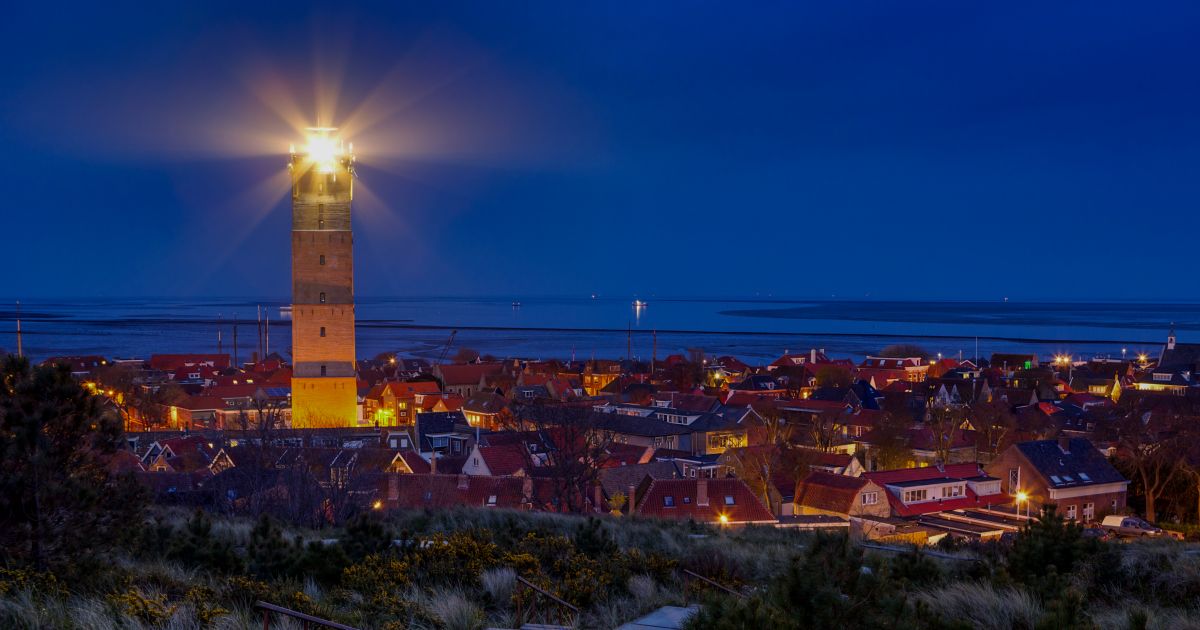
Photo by Sara Winter. iStock
Later, in less troubled times
Hinne and Wine on the phone with their children in Canada
Leave a Reply